
The Hidden Costs of Electrifying a Fence (That Most People Never Budget For)
The Hidden Costs of Electrifying a Fence (That Most People Never Budget For)
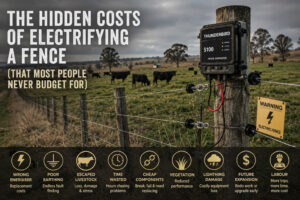
When most people ask, “How much does it cost to electrify a fence?”, they’re usually thinking about the obvious expenses.
The energiser.
The wire.
The insulators.
Maybe the earth stakes.
Ironically, those are rarely the costs that hurt the most.
After helping Australian farmers design electric fencing systems for years, we’ve found the biggest expenses often appear after the fence has been installed—and almost all of them are preventable with good planning.
1. Buying the Wrong Energiser
This is easily the most common—and often the most expensive—mistake.
Many farmers choose an energiser by comparing kilometre ratings because it feels like the easiest way to compare products.
Unfortunately, kilometre ratings rarely tell the whole story.
A fence that performs perfectly in winter can become unreliable once spring grass starts growing.
A property that begins with two paddocks can become ten.
An energiser that looked like a bargain suddenly isn’t large enough.
We’ve seen countless customers replace energisers that were only a year or two old—not because the energiser failed, but because it was never the right size for the long-term plan.
What it can cost
- Replacing an energiser: $400–$2,500+
- Time diagnosing problems that existed from day one.
- Labour removing and reinstalling equipment.
How to avoid it
Design the entire property first—even if you’re only building Stage One.
Buying one correctly sized energiser is almost always cheaper than buying two.
2. Poor Earthing – The Cause of More Problems Than Almost Anything Else
If there is one component farmers consistently underestimate, it’s the earth system.
People are happy to invest in a premium energiser, then try to save money by installing a single short earth stake.
The result?
The energiser performs perfectly.
The fence doesn’t.
Poor earthing creates:
- Weak fence voltage.
- Inconsistent performance.
- Difficult fault finding.
- Frustrated livestock owners.
- Endless replacement of perfectly good components.
In our experience, inadequate earthing causes more electric fence problems than almost anything else.
What it can cost
- Hours—or days—walking fences.
- Multiple unnecessary replacement parts.
- Repeat service calls.
- Reduced livestock control.
How to avoid it
Never think of the earth system as an accessory.
It isn’t.
It’s half of the electric fence.
3. Escaped Livestock
This is where electric fencing becomes genuinely expensive.
One fence failure can mean:
- Hours mustering escaped cattle.
- Damaged crops.
- Broken boundary fences.
- Neighbour disputes.
- Reduced production.
- Vehicle accidents.
- Injured livestock.
Compared to those costs, spending a few hundred dollars more during installation often becomes one of the cheapest decisions you’ll ever make.
We’ve seen farmers spend weeks comparing product prices…
…then lose far more from one escaped mob of cattle.
4. Time Spent Chasing Faults
This hidden cost rarely appears in anyone’s budget.
Every time the fence loses voltage, somebody has to find out why.
That often means:
- Walking kilometres of fence.
- Testing individual sections.
- Checking joins.
- Clearing vegetation.
- Replacing insulators.
- Testing earth systems.
- Retesting the fence.
Time has value.
Every hour spent fault-finding is an hour not spent running the farm.
One of the biggest advantages of a properly designed electric fence is how little attention it demands.
5. Cheap Components That Don’t Stay Cheap
It’s easy to compare prices online.
It’s much harder to compare how products perform after five or ten Australian summers.
Cheap components often become expensive through:
- UV damage.
- Brittle plastics.
- Rusty connections.
- Poor conductivity.
- Broken clips.
- Constant small repairs.
Replacing hundreds of failed insulators costs far more than buying quality products once.
Experienced farmers understand something many first-time buyers don’t:
The cheapest fencing product is often the one you never have to replace.
6. Grass and Vegetation Management
Every blade of grass touching an electric wire steals power.
During good seasons we’ve seen fences lose thousands of volts—not because anything was broken, but because vegetation placed a far heavier electrical load on the system than the original design allowed for.
That often creates ongoing labour through:
- Slashing.
- Spraying.
- Whipper snipping.
- Manual clearing.
Good design doesn’t eliminate vegetation management.
But it gives you far more tolerance before vegetation begins affecting fence performance.
7. Solar Battery Replacement
Solar electric fencing systems are an excellent option where mains power isn’t available.
But batteries are consumable items.
Every few years they will eventually require replacement.
Many people budget for the solar panel…
…but forget the battery.
The encouraging news is that solar systems avoid ongoing mains electricity costs, making them extremely economical over the long term when properly designed.
8. Lightning Damage
Lightning doesn’t need to strike your energiser directly.
Nearby strikes can travel along fence wires and damage equipment within seconds.
Every summer we hear from customers whose energisers stopped working after storms.
In many cases, relatively inexpensive lightning protection would have prevented thousands of dollars in damage.
It’s one of those components that feels unnecessary…
…right up until the day you need it.
9. Expansion Costs
Today’s fencing plan rarely stays today’s fencing plan.
We’ve heard it countless times.
“We’ll only have two paddocks.”
Twelve months later…
“We’ve divided another six.”
If the original system wasn’t designed with future expansion in mind, perfectly good equipment suddenly needs replacing.
That’s one of the reasons we always ask customers about their five-year plans.
You don’t have to build the entire system today.
But you should design it today.
10. Labour Is Usually the Biggest Cost
Whether you’re hiring contractors or building the fence yourself, labour is expensive.
Every unnecessary repair…
Every return trip…
Every poor join…
Every broken insulator…
Every avoidable voltage fault…
…adds labour.
That’s why experienced farmers often say:
“The cheapest fence is the one you only build once.”
Good design keeps paying you back every year through reduced maintenance.
The Hidden Cost Nobody Talks About
The biggest hidden cost isn’t actually financial.
It’s confidence.
When an electric fence keeps failing, farmers stop trusting it.
Instead of relying on the fence, they begin:
- Checking livestock more often.
- Carrying temporary repair gear.
- Worrying after every storm.
- Wondering whether stock have escaped.
A reliable electric fence gives you something that’s difficult to place a dollar value on.
Peace of mind.
And for many farmers, that’s worth more than any individual component.
Three Real Examples That Show Why Cost Can Vary So Much
Every week we speak with farmers asking exactly the same question:
“How much will it cost to electrify my fence?”
The answer depends entirely on what they’re trying to achieve.
Here are three examples based on the types of conversations we have every week.
Names and locations have been changed, but the situations are very real.
Example 1 – The Small Acreage Owner
A customer with around fifteen acres wanted “one of those cheap fence chargers” to stop two horses rubbing through an ageing timber fence.
His budget was around $200 because he assumed the energiser was the whole job.
After asking a few questions we discovered the existing fence was actually in good condition.
Rather than rebuilding hundreds of metres of timber fencing, we recommended:
- A quality mains-powered energiser.
- Offset insulators.
- One electrified wire.
- Two proper earth stakes.
- Lead-out cable.
- A digital fence tester.
Final investment
Approximately $700–$1,000.
Within days the horses stopped leaning through the fence to reach greener grass.
Instead of replacing broken timber rails every year, the electric wire protected the fence itself.
The lesson
Sometimes spending a few hundred dollars more on the right system saves thousands in future fence repairs.
Example 2 – The Beef Producer
A cattle producer wanted to electrify approximately five kilometres of fencing.
He’d already selected a 50-kilometre-rated energiser he’d found online.
Once we discussed the property, we discovered:
- Multiple paddocks.
- Heavy seasonal grass.
- Plans for rotational grazing.
- Future expansion.
Instead of simply selling the energiser he’d chosen, we designed a system that included:
- A higher-output energiser.
- Multiple earth stakes.
- Underground lead-out cable.
- Cut-out switches.
- Better strain assemblies.
- Expansion capacity.
Final investment
Approximately $2,500–$4,500.
The result wasn’t just a stronger fence.
It was a system capable of growing with the farm without replacing major components a few years later.
The lesson
Buy for where your farm is going—not just where it is today.
Example 3 – The Large Grazing Operation
A commercial grazing enterprise wanted pricing on “a really big solar energiser.”
They assumed purchasing the largest solar unit available would solve the problem.
It didn’t.
The energiser wasn’t actually the biggest challenge.
The property needed:
- Correct solar sizing.
- Larger battery capacity.
- Extensive earthing.
- Underground cable.
- Lightning protection.
- Multiple isolation switches.
- Strategic energiser placement.
- Expansion planning.
Final investment
Approximately $12,000–$20,000+, depending on the final design.
The result was reliable voltage across the property rather than years spent chasing faults.
The lesson
Large electric fencing projects aren’t product purchases.
They’re infrastructure projects.
Good design becomes more valuable than simply buying bigger equipment.
The Common Theme
These three projects ranged from under $1,000 to well over $10,000.
Yet every one of them started exactly the same way.
Not with a product recommendation.
Not with a quotation.
With questions.
That’s why, when someone asks us,
“How much does it cost to electrify a fence?”
we don’t immediately recommend an energiser.
We start by understanding the livestock, the property, the existing fencing and the long-term goals.
Because once those answers are known, the right system—and the right budget—usually become much clearer.