
How Much Does It Cost to Electrify a Fence?
How Much Does It Cost to Electrify a Fence? (The Answer Most Farmers Never Get)
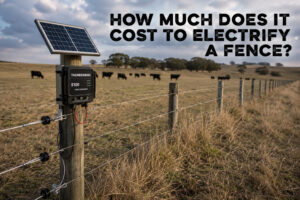
If you ask ten people how much it costs to electrify a fence, you’ll probably get ten different answers.
One person will tell you they did it for a few hundred dollars.
Another will say it cost several thousand.
Someone else will insist you need the biggest energiser you can afford.
So who’s right?
The truth is…
They all might be.
After helping Australian farmers with tens of thousands of electric fencing enquiries over the years, we’ve learned that the biggest mistake people make isn’t buying the wrong energiser.
It’s asking the wrong question.
The Biggest Myth About Electric Fence Costs
If there’s one thing that makes experienced electric fencing specialists cringe, it’s hearing someone say:
“I’ve got 5 kilometres of fence. What size energiser do I need?”
It sounds like a sensible question.
Unfortunately, it’s the wrong question.
And it’s responsible for more undersized, oversized and poorly performing electric fencing systems than almost anything else.
Why This Myth Exists
For years, electric fence energisers were marketed almost entirely by their kilometre rating.
50 kilometres.
100 kilometres.
200 kilometres.
The message was simple.
Measure your fence.
Buy the matching energiser.
Problem solved.
Unfortunately, that’s not how electric fencing works.
Those kilometre ratings are measured under ideal laboratory conditions:
- Perfect earthing.
- Clean fence lines.
- Excellent insulation.
- No vegetation load.
- Minimal leakage.
Real Australian farms are rarely ideal.
Electricity Doesn’t Care About Kilometres
Electricity doesn’t care how long your fence is.
It cares how much work it has to do.
A two-kilometre fence running through thick summer grass can place a heavier electrical load on an energiser than a clean ten-kilometre boundary fence.
Likewise, two properties with exactly the same fence length can require completely different systems.
One might have:
- One straight boundary fence.
- Good soil.
- Trained cattle.
- Mains power.
- Minimal vegetation.
The other might have:
- Twelve rotational grazing paddocks.
- Numerous gateways.
- Heavy seasonal grass.
- Sheep or goats.
- Solar power.
- Future expansion planned.
Although the fence length is identical, the electrical demand is completely different.
That’s why experienced designers ask questions about livestock, vegetation, earthing and future plans long before they ask about kilometres.
Fence length is only one small piece of the puzzle.
So… How Much Does It Cost to Electrify a Fence?
The honest answer is:
Most Australian electric fencing projects fall somewhere between about $500 and well over $10,000.
That isn’t because suppliers are trying to avoid giving a straight answer.
It’s because “electrifying a fence” can mean completely different things.
For example:
Around $500–$1,000
Typically involves improving an existing fence on:
- Small acreage.
- Horse properties.
- Lifestyle blocks.
- Small cattle paddocks.
Usually the existing fence is already in good condition, and you’re simply adding electric wire to encourage livestock to respect it.
Around $2,000–$5,000
This is where many working farms sit.
These projects often include:
- Larger energisers.
- Permanent wire.
- Multiple earth stakes.
- Underground lead-out cable.
- Several gateways.
- Cut-out switches.
- Expansion capability.
At this level you’re no longer buying individual products.
You’re building a reliable electric fencing system.
$10,000+
Large commercial projects are different again.
They often involve:
- Multiple paddocks.
- Rotational grazing.
- Large solar systems.
- Boundary fencing.
- Remote locations.
- Heavy-duty infrastructure.
- Future farm expansion.
At this point the cost isn’t driven by the energiser.
It’s driven by the design.
The Biggest Mistake We See
The single biggest mistake Australian farmers make is buying products before designing the system.
Ironically, that’s usually the decision that creates the most wasted money.
The most wasted time.
And the most frustration.
People naturally start by asking:
“Which energiser should I buy?”
But that’s a little like asking which tyres you should buy before deciding what vehicle you’re driving.
The product isn’t the starting point.
The design is.
Why Design Comes Before Price
Imagine two customers both ring us asking for a quote to electrify one kilometre of fencing.
Customer One wants to stop two horses rubbing on an existing timber fence beside the house.
Customer Two wants to contain goats in scrub country using solar power, with plans to divide the paddock into six grazing cells over the next three years.
Both have one kilometre of fencing.
Neither needs the same solution.
The horse owner may only require:
- Offset insulators.
- One electrified wire.
- A quality mains energiser.
- Proper earthing.
The goat producer may need:
- Multiple live wires.
- A significantly larger energiser.
- Solar power.
- Additional earth stakes.
- Better insulation.
- Expansion planning.
- Vegetation management.
The fence length hasn’t changed.
Everything else has.
That’s why experienced electric fencing specialists don’t start by recommending products.
They start by asking questions.
The Questions We Ask Before We Ever Recommend an Energiser
When someone contacts Horsley Wholesale asking,
“How much will it cost to electrify my fence?”
we don’t immediately start adding products to a shopping cart.
Instead, we ask questions like these.
What Are You Trying to Keep In—or Keep Out?
Different animals behave differently.
That changes everything.
For example:
- Cattle are generally easier to train to electric fencing.
- Horses require visibility as well as safety.
- Sheep often need additional wires or electric netting.
- Goats have an incredible ability to test weak fences.
- Dogs, pigs and feral animals all require different fence designs.
Until we know the livestock, we can’t accurately recommend the system.
Is This Permanent or Temporary?
Temporary fencing usually involves:
- Tread-in posts.
- Polywire or tape.
- Reels.
- Portable energisers.
Permanent fencing typically requires:
- Better wire.
- Proper insulators.
- End assemblies.
- Lead-out cable.
- Reliable earthing.
- Cut-out switches.
- More robust infrastructure.
Temporary fencing can have a lower upfront cost.
Permanent fencing often provides the better long-term value.
How Long Is the Fence Today—and Eventually?
This question surprises many people.
We’re often less interested in today’s fence than tomorrow’s.
A customer may tell us they only need to electrify 500 metres.
After a few more questions we discover their long-term goal is a fully developed rotational grazing system with ten paddocks.
If we only design for today’s project, we may be forcing them to replace perfectly good equipment in two years.
Good design plans for the future—even if construction happens in stages.
How Many Paddocks Will the System Run?
This question often has a bigger impact on price than fence length.
Every additional paddock usually means more:
- Gateways.
- Underground cable.
- Connections.
- Cut-out switches.
- Strain assemblies.
- Labour.
Five kilometres divided into twelve grazing cells is a completely different project to one five-kilometre boundary fence.
That’s why one of our first questions is often:
“How many paddocks?”
—not—
“How many kilometres?”
Is There Already a Fence There?
Sometimes electrifying a fence is surprisingly affordable.
If there’s already a solid existing fence, the job may simply involve adding:
- Offset insulators.
- Electric wire.
- An energiser.
- A proper earth system.
But if the existing fence is leaning, rusty, poorly strained or constantly shorting out, the electric fence will only ever perform as well as the structure underneath it.
Sometimes the cheapest-looking job quickly becomes the most expensive because the old fence needs repair before it can be electrified.
Is There Mains Power Available?
Mains power is usually the most reliable and economical long-term option where available.
If not, we look at battery or solar systems.
Solar systems perform exceptionally well when they’re designed correctly, but they require additional components including:
- Solar panels.
- Batteries.
- Mounting systems.
- Protection from livestock.
- Proper charging capacity.
That naturally changes the project cost.
How Much Vegetation Will Touch the Fence?
Grass is one of the biggest reasons electric fencing underperforms.
Every blade of grass touching the wire steals energy.
A clean fence line can often operate with a smaller energiser.
A fence running through creek country, scrub or heavy seasonal growth needs a completely different approach.
Vegetation isn’t just a maintenance issue.
It’s a design issue.
Are the Animals Already Trained?
Experienced cattle usually respect a quality electric fence.
Untrained livestock often require stronger systems, better visibility or dedicated training paddocks.
Once animals learn they can push through a weak fence, changing that behaviour becomes much harder—and much more expensive.
How Important Is Reliability?
There’s a world of difference between:
- Keeping a family dog away from the vegetable garden.
And:
- Holding cattle beside a busy highway.
The consequences of failure often determine the design far more than the fence length.
What Does Success Look Like?
Finally, we ask what the customer actually wants to achieve.
Some simply want the cheapest way to get started.
Others want a system they’ll never have to think about again.
Neither goal is wrong.
They’re simply different projects.
And that’s why there is no universal answer to the question:
“How much does it cost to electrify a fence?”
The right answer always starts with understanding the property—not measuring the fence.